Wednesday, March 24, 2010

EcoCenter Roof is Sealed up and Ready for Planting!


Friends:

Over the last week the EcoCenter roof was sealed up with a Foam in Place Poly-Urea system and an anti-uv acryclic topcoat. Here are some advantages to sealing the roof:
Highest "R" Value of up to 7.14 per inch enabling it to provide more thermal resistance with less material than any other insulation; Seamless - SPF forms a seamless insulated roofing system which mitigates leaking and water penetration;
Elimination of Ponding Water; Lightweight - ASPF weighs between 2-3 pounds per cubic foot. And most importantly it will support our living roof system!

Laurie

Saturday, March 20, 2010

Living Parapet's on our Living Roof!


Friends:

This week the Habitat Gardens team fabricated all of the understructure for the Vegetative Roof's parapets [the structures that "edge" the vegetative roof]. Thanks to a great design by Evodesign, the parapets will be loaded up with lots of natural "found objects" from pine coans to pieces of ceramics and granite. Over the next few weeks we will be installing these parapets against the beutiful plants that are coming on line.

Come down this week! Starting Tuesday we are planing the roof!

Laurie

Thursday, March 18, 2010

Living Roof Membrane Installed Today!


Friends:

I can't describe the incredible feeling of watching the EC's living roof come on line. After twelve years of work and planning--we are finally watching our living classroom come on line--with all of the systems that we aimed for thank to the Administration's ARRA funding to bring additional resources online.

In partnership with Habitat Gardens and Urethane Roofing, we laid down the first portion of our membrane. The polyurethane membrane is sprayed directly onto the OSB platform on the roof deck. As the CEO of Urethane Roofing stated yesterday, this provides a bullet proof membrane that will protect the building from any water element for over twenty years. Some benefits of this membrane include: high durability, performance, energy efficiency, lower maintenance, cost-effectiveness, and low environmental impact.

We will be ready to install our Living Roof on Monday!!!!

Come on down to the site to see the action!

Laurie

Saturday, March 13, 2010

Asian Neigborhood Design Visits the EcoCenter!


Friends:

Today the Herons Head Park team and the EcoCenter Team met with Asian Neighborhood Design to give the students at ANDNET a sneak peak at some of our living systems. We spent a great deal of time explaining the relevance of our building design within the framework of the commmunity of Bayview Hunterspoint and why we decided to move "off the grid". We talked about the concentration of sewage treatment in our community as well as the burden of carrying the city's two largest power plants [one already demolished and one soon to be], as well as reviewing some of the land use problems from brownfields to the superfund site. The students were really excited about what we are accomplishing and they want to be involved!

Our new team has hired two graduates of the ANDNET apprenticeship program and we are working on training the graduates about horticulture, living roofs, and low impact development design--as well as harvesting rainwater!

You will notice we extended our downspout from the building to move all roof water off site while we wait for the shipment of our rainwater tanks. Hopefully they will be here soon!

Come down and visit!

Laurie

Thursday, March 11, 2010

Blog on EcoCenter Living Systems


Friend! I am so excited about the work happening at the EcoCenter. Its a dream come true! Our living roof, constructed wetlands, rainwater tanks are all coming on line in the next fifty days!

You can go to our living systems blog at: http://heronshead.blogspot.com/ to find out more about our work--

Or, you can visit us at the center!

More to come!

Laurie

Sunday, March 7, 2010

LEJ and Habitat Gardens Teams up for the Living Roof!


NEWS RELEASE

San Francisco, CA, February 28, 2010 -- Habitat Gardens, a leading native
landscape and living architecture firm, today announced it has been awarded a
contract to design and install the living roof at The EcoCenter at Heron’s Head Park in San Francisco, a 23-acre wetland park in Bayview Hunters Point.

The EcoCenter, a project of Literacy for Environmental Justice, is an environmental education center to educate the general public about renewable energy, pollution and greenhouse reduction, wastewater treatment, “green” building materials, and the green economy. The EcoCenter project is being funded by the American Recovery and Reinvestment Act 2009.

“We are delighted to be working with Habitat Gardens on the EcoCenter’s green roof and have the project benefit from the firm’s deep experience and enthusiasm for living architecture,” said EcoCenter Project Manager Laurie Schoeman. “After a competitive review of capabilities and proposals, it was clear that the team at Habitat Gardens were the best qualified for the job.”

“The EcoCenter is a one-of-a kind, groundbreaking project with which we are proud to be associated. It will leverage all that we have learned in the last 10 years pioneering the field of living architecture and green roofs. The work will illustrate to all those who visit the center the beauty of green roofs as well as their effectiveness at temperature, sound and light control,” said Casey Lyon, Founder of Habitat Gardens.

The EcoCenter is located at Cargo Way and Jennings Street at the Port of San Francisco’s Heron’s Head Park (Pier 98). The center will provide space to upwards of 100 students in both an indoor and adjacent outdoor classroom space with the goal of providing a hands-on example of low impact development with an emphasis on environmental justice, reflecting its location in one of the most historically polluted communities in the region. The EcoCenter project is a partnership between the non-profit organization Literacy for Environmental Justice, the Port of San Francisco, the San Francisco Department of the Environment, and the State Coastal Conservancy.

Habitat Gardens offers native landscape and living architecture services for LEED certification on commercial and residential buildings. Throughout the last ten years Habitat Gardens’ team of certified green roof and living wall professionals has worked on over 40 green roofs throughout California. The firm was founded in 2000 and is headquartered in Monterey, California. To learn more about Habitat Gardens, visit www.habitatgarden.com

For further information Habitat Gardens: Casey Lyon (831) 238-0038; casey@habitatgarden.com or Awie Smit (415) 298-3536; awie@habitatgarden.com
For further information Literacy for Environmental Justice: Laurie Schoeman (415) 694-1555; lcprojectmanager@lejyouth.org


Thursday, February 18, 2010

LED's Light up the Ecocenter


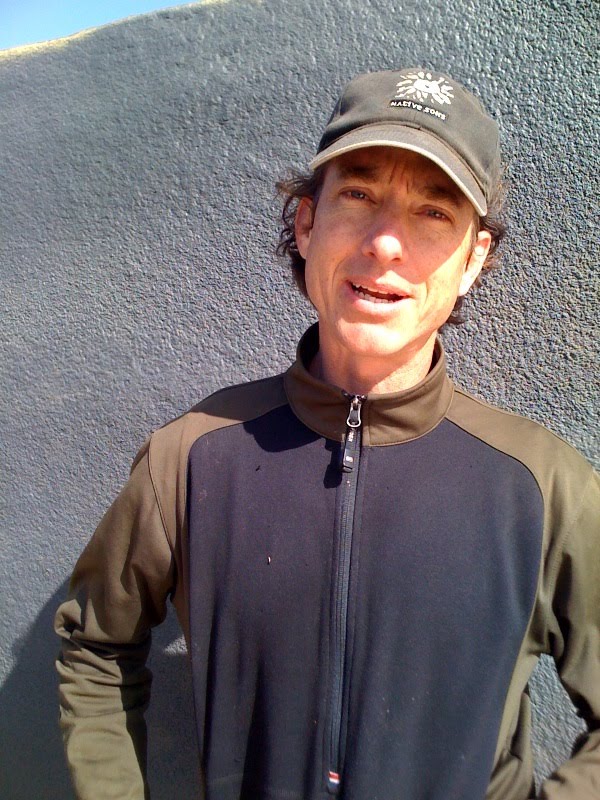
Friends: I spent a good part of the day with a Chris de Monterey, the chief architect behind the modern, but ancient, Camera Obscura. Chris and I selected a package of LED lights to illuminate the EcoCenter.

We have made a decision, rather than go with standard compact flourescents, to outfit the entire building with super efficient lED lights. This will help increase electrical efficiency at the center so as to not overload our stand alone solar array.

LED lighting has been around since the 1960s, but is just now beginning to appear in the residential market for space lighting. The LED is based on the semiconductor diode. When a diode is forward biased (switched on), electrons are able to recombine with holes within the device, releasing energy in the form of photons. Basically, LEDs are just tiny light bulbs that fit easily into an electrical circuit. But unlike ordinary incandescent bulbs, they don't have a filament that will burn out, and they don't get especially hot. They are illuminated solely by the movement of electrons in a semiconductor material, and they last just as long as a standard transistor. This effect is called electroluminescence and the color of the light (corresponding to the energy of the photon) is determined by the energy gap of the semiconductor.

LEDs present many advantages over incandescent light sources including lower energy consumption, longer lifetime, improved robustness, smaller size, faster switching, and greater durability and reliability. LEDs have several advantages over conventional incandescent lamps. For one thing, they don't have a filament that will burn out, so they last much longer. Additionally, their small plastic bulb makes them a lot more durable. They also fit more easily into modern electronic circuits.

But the main advantage is efficiency. In conventional incandescent bulbs, the light-production process involves generating a lot of heat (the filament must be warmed). This is completely wasted energy, unless you're using the lamp as a heater, because a huge portion of the available electricity isn't going toward producing visible light. LEDs generate very little heat, relatively speaking. A much higher percentage of the electrical power is going directly to generating light, which cuts down on the electricity demands considerably.